How Dirty Pool Filters Cost You Money
A dirty swimming pool filter doesn't always look like an expensive problem, but it is: when a pool filter is clogged, water flow drops and filtration efficiency falls, which often means longer pump runtimes, more chemical use, cloudy water, algae growth, and extra strain on pool equipment—all of which raise operating and maintenance costs. There may not be a leak. The pump may still be running. The water may even look reasonably clear.
But when a pool filter becomes overloaded with dirt, algae, oils, leaves, and other debris, the entire circulation system has to operate under less-than-ideal conditions. Chemicals may not circulate as efficiently, debris stays in the water longer, and what should have been routine pool filter cleaning can turn into additional chemical treatments, equipment troubleshooting, premature wear, or a larger service call.
For residential pool owners and anyone responsible for regular pool care, understanding this chain reaction helps explain why filter maintenance has such a direct effect on monthly costs and long-term equipment life. This guide breaks down how pool filters work, what happens when they get dirty, the warning signs to watch for, how often to clean them, and the right cleaning approach for cartridge, sand, and DE filters so you can avoid higher electricity bills, poor water quality, and unnecessary repairs.
Keeping the filter clean is one of the simplest forms of preventive pool maintenance, and over the life of a swimming pool, it can save a surprising amount of money.
What Does a Pool Filter Actually Do?
Your pool pump and filter work together. The pool pump pulls water from the skimmer and main drain, moves it through the filtration system, and returns cleaner water to the swimming pool.
The filter's job is to do just what its name suggests: capture suspended material before that water returns. Depending on the pool, that can include dirt, dust, leaves, pollen, dead algae, insects, hair, oils, and fine organic debris.
Without proper filtration, much of that material would remain suspended in the water or settle onto the pool surfaces. Chlorine is extremely important, but chlorine and filtration do different jobs. Chlorine sanitizes the water. The filter physically removes debris. A healthy pool needs both.
What Happens When a Pool Filter Gets Dirty?
As debris accumulates inside the filter, it becomes increasingly difficult for water to move through it. Think about trying to breathe through a clean piece of fabric compared with one packed full of dirt. The same basic concept applies to filtration.
A dirty filter creates resistance to water flow. Depending on the system, homeowners may notice higher filter pressure, weaker return flow, reduced skimmer action, cloudy pool water, debris remaining suspended, longer filtration times, recurring algae, or poor water clarity.
None of those automatically proves the filter is dirty, because several pool problems can produce similar symptoms. But the filter should absolutely be one of the first things checked when circulation or water clarity begins to decline.
A Dirty Filter Can Reduce Water Flow
One of the biggest consequences of a clogged filter is reduced circulation. Your pool relies on moving water. The sanitizer needs to circulate throughout the pool, debris needs to reach the skimmer and filter, chemicals need to mix into the water, and areas with poor circulation are more likely to collect debris and become vulnerable to algae.
When the filter becomes excessively dirty, the filtration system may move less water during the same pump runtime. That means the pump can run for hours while accomplishing less actual circulation. For pool owners, that is wasted operating time.
Poor Circulation Can Increase Chemical Costs
Pool chemicals work best when they are distributed properly. If circulation becomes weak, chlorine and other chemicals may not spread through the pool as efficiently. You can end up with areas receiving plenty of circulation while other parts of the pool become stagnant.
Those low-flow areas can become ideal places for algae to begin developing. Then the homeowner may respond by adding more chlorine, algaecide, or other chemicals. But if poor filtration and circulation contributed to the problem, adding chemicals alone may not solve it. Poor circulation is also one of several reasons chlorine sometimes doesn't work as expected, even when pool owners keep adding more.
That is how a neglected filter can indirectly increase the cost of pool chemicals. You are spending more money treating symptoms instead of correcting the filtration problem underneath them.
Dirty Filters Can Contribute to Cloudy Water
Cloudy water has many possible causes. It can result from poor water chemistry, early algae growth, calcium precipitation, heavy swimmer usage, inadequate sanitizer, circulation problems, or filtration issues.
A dirty pool filter can absolutely contribute. The filter may no longer be processing water efficiently enough to remove the fine particles suspended in the pool. That can leave the water looking dull or hazy even though the chemistry appears reasonably close to normal.
Homeowners sometimes respond by adding clarifiers, shock, or other products. Those products may have their place, but if the filter is overdue for cleaning, that problem needs to be addressed too. A clean filter gives the system a much better chance of restoring clear water. Proper filtration also helps keep the pool sparkling by improving circulation and removing lingering contaminants.
Algae Makes a Dirty Filter Even Worse
Algae and filters can create a frustrating cycle. Poor circulation can contribute to algae growth. Then, once algae develops, the filter starts capturing huge amounts of dead algae and organic material. That causes the filter to become dirty even faster.
Water flow drops further, the pool struggles to clear, more chlorine gets used, and the pool owner can find themselves treating the same problem repeatedly.
During an algae cleanup, filter maintenance may need to happen much more frequently than it would during normal weekly service. In some cases, a cartridge may need to be cleaned several times while the pool is clearing because it quickly becomes loaded with dead algae. This is why regular filter maintenance is so important.
How Dirty Filters Can Cost You Electricity
A filtration system with restricted flow isn't operating efficiently. If the pool requires longer pump runtimes because water is moving poorly or the pool is taking longer to clear, the homeowner may ultimately spend more on electricity and face higher costs from inefficient operation.
This is particularly relevant when someone tries to compensate for poor filtration by simply running the pump longer. More runtime does not automatically solve a clogged-filter problem. Sometimes the pool doesn't need another four hours of pump operation. It needs the filter cleaned. Doing that on time can save money by reducing wasted energy use.
Maintaining good water flow allows the circulation system to accomplish more during its normal operating schedule.
Can a Dirty Filter Damage the Pool Pump?
A badly neglected filtration system can contribute to operating problems throughout the circulation system. However, the relationship between filter restriction and pump damage is more complicated than simply saying that every dirty filter will “burn out” a pump.
Different pumps respond differently to changing system resistance. What is clear is that a pool system operating with severely restricted flow is not operating as intended.
Poor flow can affect heaters, salt chlorinators, automation systems, and other equipment that depends on adequate circulation. It can also make existing plumbing, priming, air-leak, or pump problems more difficult to diagnose.
That is reason enough not to let a filter become excessively clogged. Protecting pool equipment means maintaining the entire circulation system, not just waiting for something to break.
Three Main Types of Pool Filters
Most residential pools use one of three primary filter types: cartridge filters, sand filters, and diatomaceous earth, or DE, filters.
They all perform the same basic job, but they are cleaned differently. Knowing your filter type is essential before attempting maintenance.
Cleaning Cartridge Filters
Cartridge filters are extremely common in residential swimming pools. Inside the filter housing are one or more pleated filter cartridges. Those pleats provide a large surface area that captures debris as water passes through them.
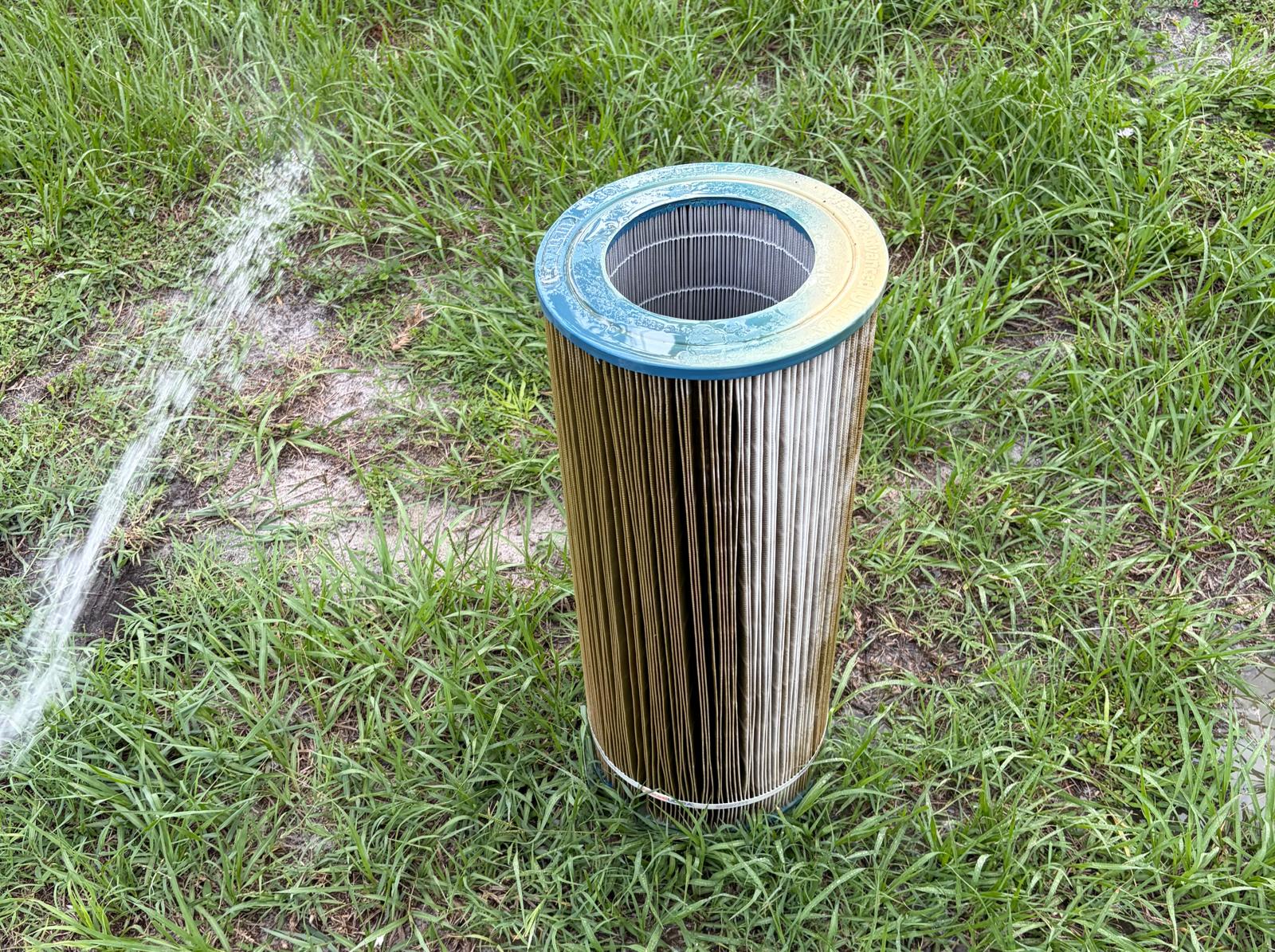
Cleaning normally involves shutting down the system, relieving pressure, opening the filter housing, removing the cartridge, and rinsing debris from between the pleats with a garden hose. The goal is not simply spraying the outside. The pleats need to be opened carefully so trapped debris can be flushed out.
Oils, sunscreen, body products, and other contaminants can sometimes require a deeper cleaning rather than a simple rinse. In some cases, pros use methods that pair high-pressure water with a chemical wash such as muriatic acid for cartridge restoration, rather than treating it as a DIY step. A cartridge that is damaged, flattened, cracked, or no longer cleaning properly may need replacement.
A well-maintained filter cartridge can last significantly longer than one repeatedly allowed to become heavily clogged.
Should You Pressure Wash a Cartridge Filter?
Usually, no. A high-pressure washer can damage the filter media. The pleats are designed to trap fine debris, but they are not designed to withstand aggressive pressure washing at close range.
A regular garden hose with an appropriate spray nozzle is generally safer. The idea is to clean the cartridge, not blast holes through it.
Cleaning Sand Filters
Sand filters operate differently. Pool water passes through a tank containing filtration media, traditionally pool-grade sand. The sand traps debris while the filtered water returns to the pool.
Instead of removing and spraying off cartridges, sand filters are normally cleaned by backwashing. Backwashing reverses the flow through the filter and sends trapped debris out through the waste line. The system is then typically rinsed before returning to normal filtration mode.
The exact procedure depends on the equipment installed. Sand itself also doesn't last forever. Over time, the filter media can become less effective and may eventually need replacement or deeper service.
Cleaning DE Filters
DE filters, or diatomaceous earth filters, can provide very fine filtration, and many pool owners hire professionals to clean DE filters as part of routine maintenance when that best fits their needs and budget. They use grids or elements coated with diatomaceous earth powder. As water moves through the filter, the DE layer captures extremely fine material.
DE filters may require periodic backwashing and then recharging with the correct amount of fresh DE powder. They also need occasional disassembly and deep cleaning because backwashing alone does not always remove everything trapped inside.
This is one area where following manufacturer instructions is particularly important. Adding too little or too much DE can create problems.
When Should You Clean a Pool Filter?
There isn't one schedule that works for every swimming pool. The factors that affect cleaning schedule and service frequency include filter size, filter type, pool size, pump runtime, landscaping, number of swimmers, rainfall, algae problems, construction or dust nearby, pets using the pool, seasonal debris, and water quality.
Some filters may operate for months between cleanings under light conditions. Others can load up much faster.
This is why professional pool maintenance should use actual equipment condition and pressure readings rather than relying solely on the calendar.
Watch the Filter Pressure
The pressure gauge on the filter is an important maintenance tool. Every pool system has its own normal clean operating pressure. After the filter has been properly cleaned, note that pressure. That gives you a baseline.
A common guideline is to clean or backwash the filter once pressure has increased roughly 20 to 25 percent above the clean starting pressure, although the filter manufacturer should always take priority.
You may also hear the old rule of waiting for an 8 to 10 PSI increase. That can work on some systems, but using a percentage of the clean pressure is often more meaningful because pool systems operate at very different baseline pressures.
If a clean system runs at 10 PSI, waiting until 20 PSI is very different from a system that normally runs at 20 PSI. Know what is normal for your pool.
High Pressure Isn't the Only Warning Sign
Pressure isn't everything. A filter can need attention even when the gauge doesn't show a dramatic increase.
Watch for other changes such as weak return jets, poor skimming, cloudy water, recurring algae, debris remaining in the pool, short filter cycles, unusual circulation behavior, unusual noises, or reduced water flow.
Also make sure the pressure gauge itself actually works. An old gauge stuck on one reading isn't useful for diagnosing anything.
Why Some Filters Need Cleaning More Often
Here in Southwest Florida, filters can experience heavy debris loads. Summer thunderstorms wash dirt and organic material into pools. Warm water and strong sunlight create excellent conditions for algae if chlorine drops. Landscaping sends leaves, seeds, pollen, and other debris into the water.
Heavy swimming introduces sunscreen, oils, hair, and other contaminants. All of that eventually reaches the filtration system.
That is why saying every pool filter should be cleaned on exactly the same three-month schedule doesn't make much sense. One pool may barely dirty its cartridge during that period. Another may need attention much sooner.
Pool maintenance should respond to the actual pool.
Bigger Filters Can Save Work
Filter size makes a major difference. A larger filter has more filtration surface area. That generally means it can hold more debris before water flow becomes significantly restricted.
A properly sized or oversized filter may therefore require less frequent cleaning than a small filter serving the same pool. This can contribute to lower costs over time. This can reduce maintenance time and help the circulation system maintain good water flow for longer periods.
When replacing pool equipment, choosing the cheapest or smallest filter isn't always the most economical option in the long run.
Clean Filters Help Keep Pool Water Balanced
Filtration and balanced water work together. A clean filter cannot compensate for poor chlorine levels, and perfect chemistry cannot fully compensate for inadequate circulation and filtration.
A well-maintained swimming pool needs both.
The pump keeps the water moving, the filter removes suspended debris, chlorine sanitizes the water, and pH, alkalinity, calcium hardness, and cyanuric acid help create the proper chemical environment.
When each part of the system is doing its job, maintaining a clean pool becomes much easier. It also takes less effort to clean your pool on a regular schedule.
Neglected Filters Can Turn Routine Maintenance Into Expensive Service
This is where dirty filters truly start costing money.
Imagine a filter that hasn't been cleaned in far too long. Flow gradually decreases. The pool develops weak circulation. Chlorine demand rises. Algae begins growing. The water turns cloudy.
Now the homeowner may need additional chlorine, algae treatment, repeated brushing, multiple filter cleanings, longer pump runtime, equipment inspection, a professional service call, or replacement of neglected filter elements.
What began as routine filter cleaning has turned into a recovery job.
Regular cleaning is almost always easier and less expensive than dealing with the consequences of neglect because regular maintenance helps prevent the bigger, costlier corrective work. Filter cleaning is just one example of why regular pool maintenance saves you money by preventing small problems from becoming expensive repairs or recovery jobs.
DIY Pool Filter Cleaning vs. Professional Service
Many pool owners can perform basic filter maintenance themselves. Some owners prefer to pay for service when the filter is difficult, time-consuming, or risky to clean. For example, rinsing a cartridge filter with a garden hose can be relatively straightforward once the homeowner understands how to safely shut down the equipment and release pressure.
But some situations are better suited for professional cleaning. That can include large multi-cartridge filters, DE filter disassembly, damaged filter components, unusually high pressure, broken clamps, air entering the filtration system, persistent low flow, repeated algae problems, or filters that haven't been opened in years.
A professional service provider can also inspect the cartridges, O-rings, pressure gauge, air-relief assembly, tank condition, and other components while the system is apart. Sometimes cleaning reveals a problem that wouldn't otherwise have been visible. Understanding what's included in professional pool service can help homeowners see how routine maintenance, equipment inspections, and water testing work together to prevent problems. When a filter has ongoing issues or the system needs a closer inspection, professional help can make all the difference.
Never Open a Pressurized Pool Filter
This deserves special emphasis. A pool filter tank operates under pressure.
Never attempt to loosen the clamp, lid, or filter housing while the system is running or still pressurized. Shut the pump off, make sure it cannot unexpectedly restart, open the air-relief valve when appropriate, and confirm the pressure gauge has returned to zero.
Only then should the filter be opened according to the manufacturer's instructions.
Filter tanks contain significant stored energy when pressurized. Pool maintenance should always be done safely.
Regular Cleaning Can Extend Filter Life
Allowing dirt to remain packed deeply into a cartridge can shorten its useful life. Repeated severe clogging can deform pleats and make cartridges increasingly difficult to clean.
DE grids can become damaged. Sand filters can develop filtration problems when maintenance is ignored.
Routine maintenance keeps debris from reaching that extreme condition. That means fewer repairs, longer equipment life, and fewer unexpected expenses.
The cheapest filter is the one you don't have to replace prematurely.
A Clean Filter Makes the Whole Pool Easier to Maintain
There is a noticeable difference between a pool system with strong circulation and one struggling to move water.
A clean pool filter helps provide better water flow, better skimming, more effective filtration, improved chemical distribution, better water clarity, easier algae prevention, less unnecessary pump runtime, and fewer filtration-related service problems.
It is one of those maintenance jobs that doesn't seem especially exciting until you see what happens when it isn't done.
Pool Filter Cleaning Is Preventive Maintenance
Many pool owners think filter cleaning is simply about keeping the water clear.
It is bigger than that.
Regular cleaning helps the entire filtration system operate correctly. It protects circulation, supports proper chemical distribution, helps reduce the conditions that allow algae to grow, can prevent routine maintenance from turning into expensive corrective work, and helps homeowners get more life from expensive pool equipment.
A pool filter quietly does its job every day. Keeping that filter clean allows everything else in the system to do its job too.
Professional Pool Maintenance in North Port, Florida
Southwest Florida pools deal with heat, intense sunlight, heavy summer rain, landscaping debris, long swimming seasons, and rapidly changing water conditions. All of that eventually affects the filtration system.
Our North Port pool service helps homeowners stay ahead of filtration problems, changing water chemistry, and the demands of maintaining a pool in Southwest Florida.
We also provide Port Charlotte pool service for homeowners who want reliable weekly maintenance and help keeping their pool's filtration and circulation systems operating properly.
At Harbor Line Pool Care, weekly pool maintenance involves more than adding chemicals and skimming leaves. We monitor water chemistry, circulation, filtration, equipment operation, and overall pool condition so developing problems can be caught before they turn into costly repairs or major cleanups, with services tailored to the pool’s condition and needs.
That includes recognizing when a filter is becoming overloaded and when it needs cleaning or additional attention. Residential pools can also benefit from services tailored to their specific setup.
A clean filter helps keep water moving. Good circulation helps keep chemicals distributed. Proper filtration helps keep debris out of the water. And when the entire system works together, maintaining a clean, clear swimming pool becomes much easier—and considerably less expensive.
Consistent weekly pool cleaning helps identify circulation and filtration issues before they affect water quality or require additional treatments.