What’s Included in Professional Pool Service?
What's Included in Professional Pool Service?
If you're thinking about hiring a pool service company, one of the first questions you're probably asking is: what's included in professional pool service?
At Harbor Line Pool Care, we only offer full-service weekly pool care because we take pride in the pools we maintain. We’re not comfortable simply testing the water and adding chemicals while the walls, floor, baskets, filters or other parts of the pool are being neglected—we want every pool we service to be healthy, well maintained, and looking its best.
A professional pool service should involve much more than someone stopping by once a week, adding chlorine, and leaving. A complete weekly pool service typically includes water testing, chemical balancing, skimming surface debris, brushing the walls, cleaning the floor, emptying skimmer and pump baskets, monitoring filtration, checking circulation and equipment, watching for algae, looking for leaks or water loss, and noting visible red flags around the pool.
For residential pool owners—especially homeowners in North Port, Florida—those details matter when you're comparing companies, trying to keep your pool clean and balanced, and avoid equipment damage or costly repairs. Exactly what professional service includes varies between pool companies, which is why homeowners should understand what their particular weekly maintenance plan covers.
Below, we'll break down the major parts of a complete weekly visit, the difference between pool cleaning and pool maintenance, what basic service often does not include, how often service is needed, what to do between visits, and what to look for when hiring a pool service company.
What Does Professional Pool Service Include?
A full-service residential pool maintenance visit generally includes several different jobs that work together.
Those usually include:
- Water testing
- Chemical balancing
- Pool surface skimming
- Brushing pool walls and steps
- Cleaning or vacuuming the pool floor when needed
- Emptying skimmer baskets
- Checking the pump basket
- Monitoring the filter week to week
- Checking circulation
- Inspecting visible pool equipment
- Watching for algae
- Looking for leaks or unusual water loss
- Noting visible red flags around the pool
Some services, such as major filter cleaning, equipment repairs, leak detection, or specialty chemical treatments, may be handled separately depending on the pool service company.
A professional pool shouldn't just look good when the technician leaves. The water, filtration, circulation, chemistry, and equipment should all be receiving regular attention.
1. Professional Pool Service Starts With Water Testing
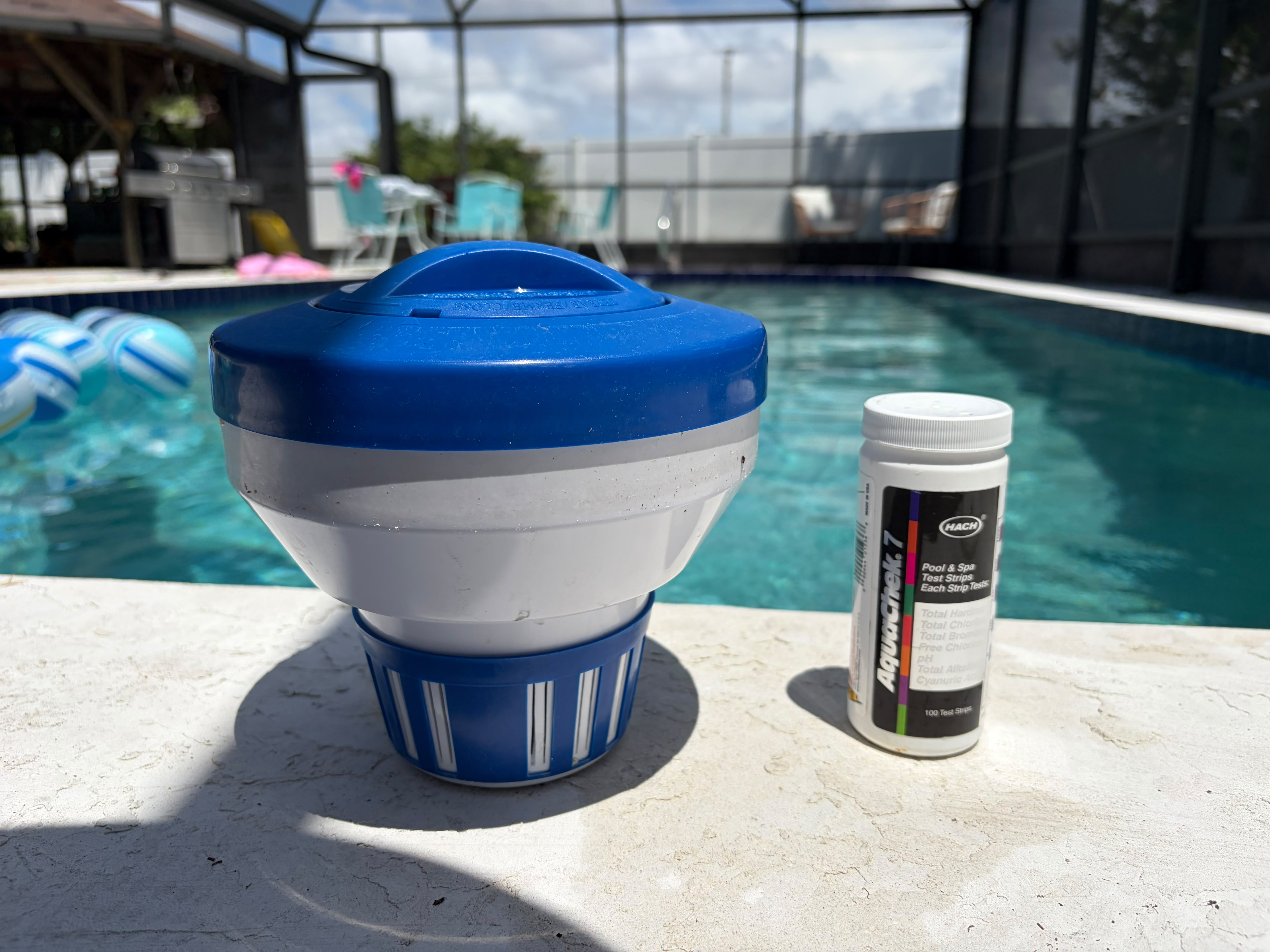
Water testing is one of the most important parts of professional pool maintenance.
A swimming pool can look perfectly clean while its water chemistry has already begun moving outside the desired range.
During weekly pool service, the technician should test the pool water and use those results to determine what chemical adjustments are actually needed.
Important readings can include:
- Free chlorine
- pH
- Total alkalinity
- Cyanuric acid
- Calcium hardness
Not every measurement requires adjustment every week.
The important thing is knowing what is happening with the water instead of guessing.
Proper water testing helps maintain water quality, supports effective sanitation, and protects pool surfaces and equipment.
A professional pool service company shouldn't determine what chemicals a swimming pool needs simply by looking at the water.
It should be tested.
2. Chemical Balancing Keeps Pool Water Stable
After water testing comes chemical balancing.
This may involve adjusting chlorine, pH, alkalinity, or other aspects of the water chemistry depending on the test results.
Good professional service isn't about adding as many chemicals as possible.
It's about adding the correct chemical, in the correct amount, when the pool actually needs it.
Low sanitizer levels can contribute to algae and poor water quality.
Improper pH can contribute to cloudy water, scaling, or corrosive conditions.
Total alkalinity affects how stable the pool's pH remains.
Calcium hardness is another important part of maintaining balanced water and protecting pool surfaces.
Cyanuric acid affects how chlorine behaves in an outdoor pool exposed to sunlight. think of it aas a conditioner sun protectant.
Measuring and applying cyanuric acid is a delicate dance. Too little and the chlorine burns off in the sun, too much and the chlorine is not effective.
These factors are connected.
That's why professional pool maintenance looks at overall water chemistry rather than treating chlorine as the only number that matters.
3. Pool Cleaning Service Includes Skimming Surface Debris
Outdoor swimming pools constantly collect debris.
Leaves, insects, pollen, grass, flowers, and other material eventually land on the water.
Florida's landscaping, wind, thunderstorms, and year-round growing season can make this a regular part of pool care.
A professional pool cleaning service should skim debris from the water before it sinks to the pool floor or travels into the circulation system.
Skimming does more than improve the appearance of the pool.
Organic debris left in the water can break down and increase the demand placed on chlorine and filtration.
Removing it is one of the simplest parts of regular pool maintenance, but it plays an important role in keeping the entire pool cleaner.
4. Pool Walls, Steps, and Surfaces Should Be Brushed
Professional pool cleaning also includes the surfaces you can't clean with a skimmer.
Pool walls, steps, benches, corners, ledges, and other surfaces can collect dirt and develop algae.
Brushing loosens material so it can be removed by filtration or vacuuming.
Special attention should be paid to areas with weaker circulation because those spots can become more vulnerable to algae growth.
Depending on the swimming pool, brushing may include:
- Pool walls
- lights
- Steps
- Benches
- Corners
- Ledges
- Areas near return jets
- The waterline or tile line
- Other areas where buildup develops
Consistent brushing is an important part of both pool cleaning and preventive pool maintenance.
A few minutes of brushing during regular weekly maintenance can help prevent a much larger algae problem later.
5. Cleaning the Pool Floor Is Part of Weekly Pool Service
Not all debris stays on the surface.
Dirt, sand, leaves, pine needles, insects, and other material eventually sink and collect on the pool floor.
Depending on the pool, floor cleaning may involve manual vacuuming, an automatic cleaner, or another vacuum system.
The important thing is that debris isn't allowed to accumulate week after week.
A clean pool floor improves the appearance of the swimming pool while also removing organic material that would otherwise remain in the water.
Professional pool cleaning should address both what is floating on top and what has settled to the bottom.
6. Skimmer Baskets and Pump Baskets Need Regular Cleaning
A swimming pool can look clean while its baskets are packed with debris.
Skimmer baskets collect leaves and other material before it travels farther into the circulation system.
When a basket becomes clogged, water flow can be restricted.
The pool pump basket can also collect debris and should be checked and cleaned as needed.
This matters because circulation connects almost every major part of pool maintenance.
Water needs to move effectively through the swimming pool, into the skimmer and drains, through the pool pump and filter, and back through the return jets.
A clogged basket can interfere with that process.
That's why basket cleaning should be part of a complete weekly pool cleaning service, not treated as an optional cosmetic task.
7. Professional Pool Maintenance Includes Filter Monitoring
Your pool filter is responsible for removing particles from circulating water.
Eventually, those contaminants accumulate.
As a filter becomes dirty, water flow may decrease and filter pressure will increase.
A professional technician should monitor filtration performance every week and recognize when filter cleaning is needed.
The exact maintenance depends on the type of filter.
Cartridge filters are removed and physically cleaned.
Sand filters and certain DE systems may require backwashing when appropriate.
The timing of filter maintenance varies based on:
- Pool size
- Filter size
- Debris load
- Swimming activity
- Landscaping
- Weather
- Water conditions
Filter cleaning doesn't necessarily need to happen during every weekly visit. Usually every 90 days.
Monitoring the filter should.
A dirty or restricted filter can contribute to poor circulation and cloudy water, which makes routine filtration checks an important part of professional pool service.
8. Weekly Pool Service Includes Circulation Checks
Good circulation helps distribute chemicals throughout the pool and move contaminated water through the filtration system.
During weekly maintenance, a pool professional should be paying attention to how the circulation system is operating.
Possible warning signs include:
- Weak return flow
- Poor skimmer suction
- Air entering the system
- Changing filter pressure
- Poor circulation in certain parts of the pool
- A pump basket that isn't filling normally
- Unusual water movement
Some circulation problems are simple.
A basket may be clogged.
A filter may need cleaning.
A valve may be positioned incorrectly.
Other problems can involve air leaks, plumbing restrictions, the pool pump, or additional equipment.
Regular professional service makes these changes easier to identify because the same pool is being observed week after week.
9. Equipment Checks Are Part of Professional Pool Service
A complete professional service should include attention to the visible pool equipment.
That doesn't mean the technician dismantles the pump and filter every week.
It means the equipment shouldn't be ignored.
Routine equipment checks may include observing:
- Pool pump operation
- Filter pressure
- Valves
- Plumbing connections
- Visible leaks
- Unusual noises
- Air entering the system
- Changes in water flow
- Water level
- Other visible equipment problems
Someone servicing a swimming pool every week becomes familiar with the way that particular pool system normally operates.
That familiarity matters.
A pump that suddenly sounds different, a small leak around a connection, or a gradual reduction in circulation may be noticed before equipment fails completely.
This is one of the major differences between simple pool cleaning and complete pool maintenance.
10. A Pool Professional Should Watch for Algae
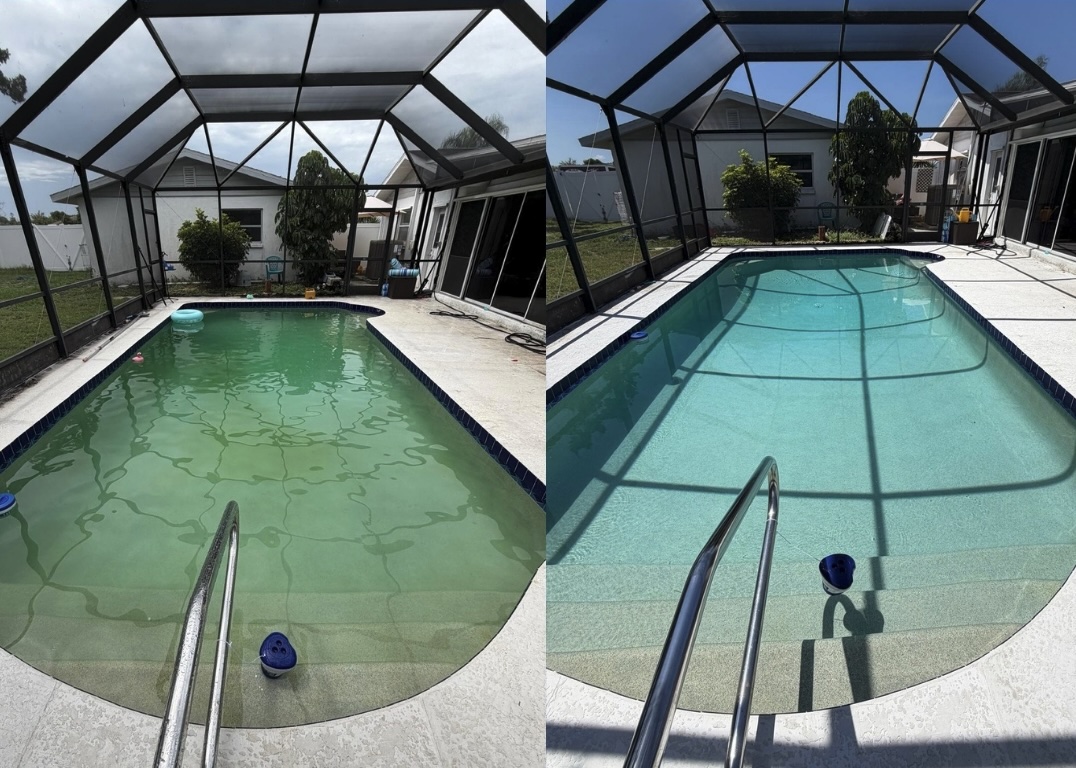
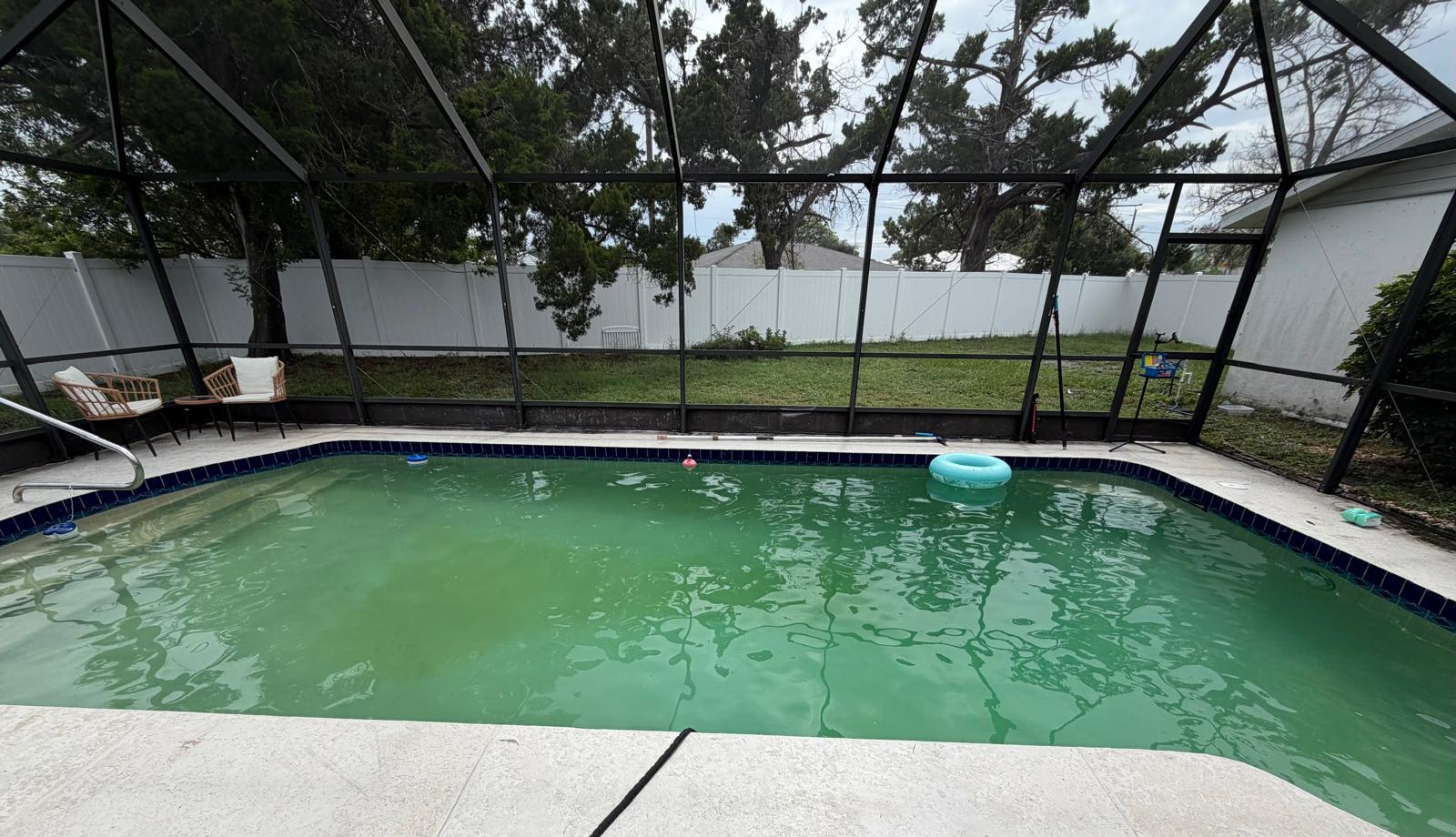
Preventing an algae problem is much easier than recovering a green pool.
During weekly pool service, the technician should watch for early algae growth on pool walls, steps, corners, benches, and other surfaces.
A small patch can sometimes provide an early warning.
Chlorine may be low.
Cyanuric acid may be too high or low.
Circulation may be weak in that area.
The filter may not be performing properly.
The water chemistry may need adjustment.
Catching the problem early can prevent it from becoming widespread.
Once algae takes over a swimming pool, restoring the water may require additional chlorine, extensive brushing, filter cleaning, longer circulation, and specialized treatment.
Professional pool maintenance is partly about recognizing those small warning signs before they become major problems.
11. Weekly Maintenance Can Reveal Water Loss and Leaks
Pools naturally lose some water through evaporation.
However, a technician servicing the same pool every week may notice when the water level is behaving differently.
An unusually low water level can affect skimmer operation and may eventually cause the pool pump to draw air.
Persistent water loss could also indicate a leak.
Standard weekly service usually isn't the same thing as professional leak detection, but regular observation can identify a possible problem that deserves further investigation.
That's another benefit of consistent weekly maintenance.
Someone is seeing the pool regularly enough to notice when something changes.
12. Professional Service Includes Looking for Red Flags
A good pool professional looks at more than the water.
Regular service provides an opportunity to notice changes around the swimming pool and equipment.
Potential red flags may include:
- Cracks or deterioration in pool surfaces
- Problematic timer
- Loose fittings
- Unusual staining
- Changes around the tile line
- Damaged or missing drain covers
- Equipment leaks
- Poor circulation
- Unusual water loss
- Abnormal equipment noises
- Other visible problems
Not every issue discovered during service will be something the pool maintenance company repairs.
Some problems may require a dedicated pool repair technician, leak detection company, electrician, or another specialist.
But identifying the problem early gives the pool owner a chance to deal with it before the issue becomes more serious.
What's the Difference Between Pool Cleaning and Pool Maintenance?
People often use pool cleaning and pool maintenance as though they mean exactly the same thing.
They overlap, but they're not identical.
Pool cleaning focuses primarily on the physical condition of the swimming pool.
That includes:
- Skimming
- Brushing
- Vacuuming
- Cleaning baskets
- Removing debris
- Keeping the pool floor and surfaces clean
Pool maintenance is broader.
Professional swimming pool maintenance also includes:
- Water testing
- Chemical balancing
- Water chemistry
- Filtration
- Circulation
- Equipment checks
- Watching for leaks
- Monitoring overall pool condition
A swimming pool can look clean while having poor chemistry.
It can also have balanced water while the pool floor is covered in debris.
A complete professional pool service needs to address both.
What Isn't Normally Included in Weekly Pool Service?
Knowing what professional pool service includes is only half of the question.
Pool owners should also know what's usually considered an additional service.
Standard weekly maintenance generally focuses on routine cleaning, water chemistry, filtration, circulation, and equipment observation.
Depending on the company, additional work may include:
- Major pool repair
- Pool pump replacement
- Leak detection
- Plumbing repairs
- Heater repairs
- Pool resurfacing
- Major algae recovery
- Green pool cleanup
- Specialty chemical treatments
- Certain filter cleanings
- Salt system repairs
- Replacement equipment or parts
Different pool companies structure their services differently.
One company may include periodic filter cleaning in its regular price while another charges separately.
One pool service company may include routine chemicals while another bills for them separately.
That is why homeowners should ask exactly what the service includes before comparing prices.
You can review our complete pool services to see the maintenance and specialty services Harbor Line Pool Care offers.
Are Chemicals Included in Professional Pool Service?
Sometimes, but not always.
Pool service companies use different pricing models.
Some include routine chemicals needed for normal weekly maintenance.
Others charge separately for all chemicals.
Another company may include common chlorine and pH adjustments while charging separately for specialty treatments.
Those specialty services could include things such as algae treatments, phosphate removal, large stabilizer corrections, or other unusual water chemistry needs.
Before hiring a company, ask:
Are routine pool chemicals included in the weekly service price?
Also ask whether there are separate charges for specialty chemicals, green pool treatments, filter cleaning, or other maintenance.
Understanding the answer makes it much easier to compare pool companies accurately.
Does Professional Pool Service Include Pool Repair?
Usually, normal professional pool service and pool repair are separate services.
Weekly maintenance may identify a problem with the pool pump, filter, plumbing, valves, heater, or another piece of equipment.
The technician can alert the homeowner that something needs attention.
Whether the same company performs the repair depends on the business.
Some pool companies provide both maintenance and repair.
Others specialize primarily in weekly pool cleaning and refer larger equipment problems to a repair specialist.
This distinction is worth understanding before hiring a pool service company.
What Should You Look for in a Pool Service Company?
Price is important, but homeowners should also check that the company has a branded professional website, Google business profile, service details, and communication.
A reliable company should clearly explain what is included in its weekly pool service.
Look for a service that includes actual water testing and isn't based on blindly adding the same chemicals every week.
The technician should also pay attention to:
- Pool cleaning
- Chemical balancing
- Filter condition
- Circulation
- Pool equipment
- Visible leaks
- Algae
- Overall pool condition
Communication matters too.
If the technician discovers a problem, the homeowner should know about it. Weekly service reports may also include chemical readings and photos, which helps clients track what was done. A mobile friendly site also makes it easier to review services and contact the company from mobile devices.
You shouldn't learn that something has been wrong for weeks only after the swimming pool turns green or the equipment stops running.
Many customers check Google before hiring, and 87% use it to evaluate local businesses. Positive online reviews can also improve a pool service's local search ranking, so they're worth checking.
Pool Maintenance Tips Between Professional Service Visits
Even when a swimming pool receives professional weekly service, homeowners can help between visits.
Good companies also answer questions between visits clearly so customers understand what changed.
A few simple pool maintenance tips include checking the pool after heavy storms, removing unusually large amounts of debris, and making sure the water level hasn't fallen too low.
If a storm fills the skimmer basket with leaves two days after weekly service, there's no benefit in leaving that basket clogged for another five days.
Likewise, if the pool pump suddenly sounds very different or you notice a major leak, contact the pool service company instead of waiting for the next scheduled visit.
Professional service works best when the homeowner and technician communicate about unusual changes between visits.
If you’re considering handling everything yourself, we also break down whether DIY pool maintenance really saves you money.
How Often Should Professional Pool Service Be Performed?
For many residential pools in Southwest Florida, weekly pool service is a practical schedule.
We take a closer look at how often a pool should really be serviced and why Florida conditions make consistency so important.
Our swimming pools operate almost year-round.
Heat, sunlight, heavy rain, tropical weather, landscaping debris, and warm water continually affect chemistry and cleanliness.
A pool that looked perfect seven days ago can behave very differently after several inches of rain or a week of intense summer temperatures.
Weekly maintenance provides a regular opportunity to:
Test the water.
Balance the chemistry.
Remove debris.
Brush the pool walls.
Clean the pool floor.
Monitor filtration.
Check circulation.
Inspect equipment.
Look for algae.
Identify potential problems.
That consistency is one of the biggest advantages of professional pool care.
Why Professional Weekly Pool Service Matters
A good professional pool service is preventive maintenance.
The different parts of weekly service work together.
Water testing guides chemical balancing.
Balanced chemistry helps protect water quality and pool surfaces.
Cleaning removes debris before it creates additional problems.
Brushing helps prevent algae growth.
Clean baskets support circulation.
Proper circulation moves water through the filter.
Filter maintenance helps keep the pool clear.
Equipment checks can identify mechanical problems early.
None of these jobs exists in isolation.
A dirty filter can contribute to cloudy water.
Weak circulation can contribute to algae.
Poor water chemistry can damage surfaces and equipment.
A low water level can affect the pool pump.
Professional weekly maintenance helps identify these problems before one small issue creates several others.
What's Included in Professional Pool Service in North Port, Florida?
So, what's included in professional pool service?
For a complete pool maintenance program, homeowners should expect regular attention to:
- Water testing
- Chemical balancing
- Pool cleaning
- Surface skimming
- Pool wall brushing
- Pool floor cleaning
- Skimmer and pump baskets
- Filtration
- Water circulation
- Pool equipment
- Algae prevention
- Water level
- Visible red flags
- Overall pool condition
Exact services vary by company, so always ask what's included with your particular plan.
If you're comparing pool companies in North Port, while looking for north port pool service, don't compare price alone. Compare what each pool cleaning service actually does every week. Local customers are often searching by location or a specific area, so clear service pages on your site should reflect each service area accurately. Keyword research helps you identify pool service keywords, the right keywords, and the search terms that match search intent instead of leaning on broad terms. Useful blog content can answer questions from website visitors and support the overall SEO strategy. A strong website should be easy for search engines to discover, include an effective meta description, and be monitored for the website's performance. SEO tools and free tools can support competitor analysis, surface keyword suggestions, build a keyword list, and track lead generation. Local services ads and focused ad spend can improve conversion rate and route density by targeting the most relevant nearby job.
For homeowners within our North Port service area, Harbor Line Pool Care provides professional weekly pool service with consistent cleaning, water testing, chemical balancing, equipment checks, and ongoing attention to your swimming pool.
The purpose of professional pool service isn't simply to make the water look good for a day.
It's to keep your swimming pool clean, balanced, properly maintained, and ready to enjoy throughout the week.
Have more questions about weekly service, chemicals, cleaning, or caring for your pool? Visit our pool service FAQ for answers to common questions from North Port homeowners.
Harbor Line Pool Care — dependable weekly pool maintnance for North Port homeowners.