What Is Cyanuric Acid (CYA) and Why Does It Matter?
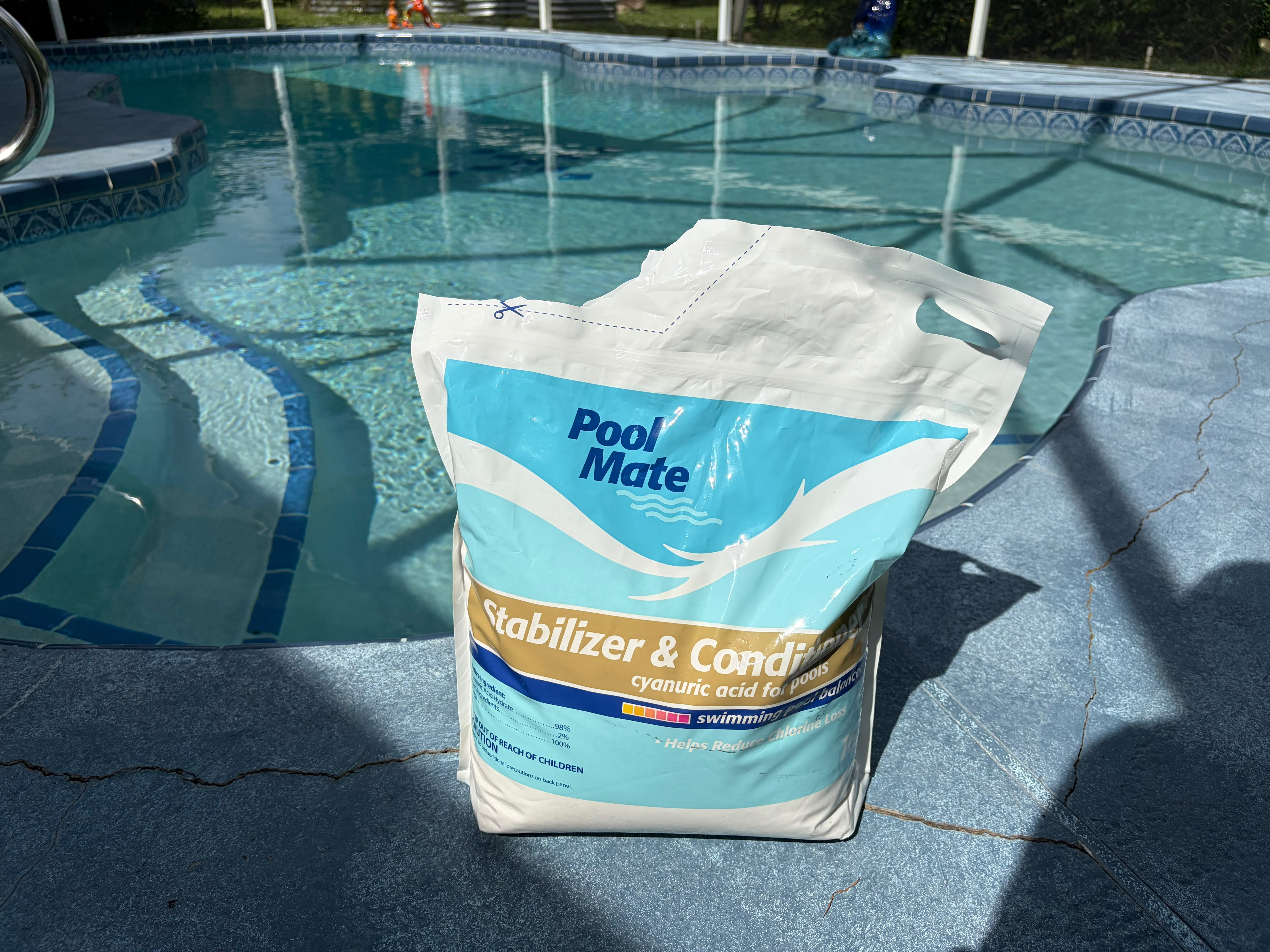
If you own an outdoor swimming pool in Florida—or you handle pool maintenance anywhere with strong sun—chlorine has one very powerful enemy: the sun. Cyanuric acid, usually abbreviated as CYA, is the chemical used in outdoor pools to protect chlorine from the sun’s ultraviolet rays so it can keep sanitizing the water, which is exactly why it matters.
You can add the correct amount of liquid chlorine to a pool, get a perfectly good free chlorine reading, and then watch that chlorine disappear surprisingly quickly under strong sunlight. That is where cyanuric acid comes into play.
Cyanuric acid is one of the most important chemicals to understand when it comes to maintaining clean, sanitary pool water. It is commonly called chlorine stabilizer or pool conditioner because its main job is protecting chlorine from degradation caused by the sun's ultraviolet rays.
That protection is especially important here in Southwest Florida, where swimming pools may receive intense sunlight for much of the year. When CYA is in the right range, chlorine lasts longer, sanitation stays more effective, and you are less likely to fight cloudy water or algae because the sun burned off your disinfectant.
But CYA is also a chemical where more is definitely not always better. Too little cyanuric acid can cause chlorine to disappear rapidly. Too much cyanuric acid can make the chlorine already in the pool work more slowly.
Finding the right balance is the goal. Below, we’ll look at what CYA does, the ideal level for different pools, what happens when it is too low or too high, how levels change over time, when saltwater and indoor pools need different treatment, how often to test, and how CYA fits into overall pool chemistry.
What Is Cyanuric Acid?
Cyanuric acid is a white crystalline compound used primarily in outdoor chlorinated swimming pools. Once dissolved in pool water, CYA interacts with chlorine and helps shield part of that chlorine from destruction by ultraviolet light.
An easy way to think about it is as sunscreen for your chlorine.
That comparison isn't chemically perfect, but it does a good job of explaining CYA's role in everyday pool care.
Without enough stabilizer, sunlight can destroy free chlorine remarkably quickly. Research on outdoor pool chemistry has shown that chlorine without CYA can lose roughly half of its concentration within about 30 minutes under sunlight. Adding cyanuric acid dramatically improves chlorine's stability.
That matters because free chlorine (FC) is the chlorine available to sanitize the pool, control algae, oxidize contaminants, and kill many types of bacteria and other microorganisms.
If sunlight keeps destroying the chlorine, maintaining a consistent sanitizer level becomes much more difficult.
Why Does CYA Matter So Much in Florida Pools?
Imagine adding liquid chlorine to your pool early in the morning.
Your test results show plenty of free chlorine. The water looks great.
Then the pool spends the next several hours underneath the Florida sun.
Without adequate cyanuric acid, a large portion of that chlorine can be destroyed before it has had a chance to do its job.
This can leave a pool vulnerable to algae and other water-quality problems even though chlorine was recently added.
That is one reason CYA plays such an essential role in North Port pool maintenance and throughout Southwest Florida. Our pools experience plenty of sunshine, high temperatures, heavy summer rain, and long swimming seasons.
Proper CYA acts like sunscreen for chlorine, protecting it from the sun's UV rays so it remains available longer instead of constantly being burned away by sunlight.
Scientific research and CDC guidance both recognize that cyanuric acid protects free chlorine from ultraviolet degradation in outdoor pools.
What Is the Ideal Cyanuric Acid Level?
For many traditional residential outdoor chlorine pools, a commonly used working range for CYA is approximately 30 to 50 parts per million (ppm), which is the ideal range for many of these pools.
That gives chlorine meaningful UV protection without unnecessarily raising the amount of chlorine required to maintain effective sanitation.
Different pool systems can call for different ranges, however.
Some saltwater chlorinator pools are operated with higher CYA concentrations, often around 60 to 80 ppm, and typically run in that range when recommended by the salt chlorine generator manufacturer.
That doesn't mean every saltwater pool automatically needs 80 ppm CYA. The equipment manufacturer's specifications, chlorine output, sunlight exposure, pool usage, water temperature, and other water chemistry all play a role.
This is why pool chemistry should be treated as a complete system rather than chasing one test result at a time. CYA is only one part of that system. Our guide to understanding pool pH without the chemistry lesson explains another major part of water balance and why pH changes over time.
What Happens When CYA Is Too Low?
When low CYA levels leave an outdoor pool below approximately 30 ppm, it may have trouble retaining chlorine during sunny weather.
You may add chlorine and see a healthy chlorine level in the morning, only to test later and discover that much of it has disappeared.
The pool may then experience recurring low chlorine, cloudy water, algae growth, or unusually high chlorine consumption.
This sometimes causes homeowners to believe there is something wrong with the chlorine they are buying.
The problem may simply be that the chlorine has very little protection from sunlight, which reduces chlorine effectiveness and can interfere with chlorine killing bacteria.
Adding CYA into the proper range can make chlorine significantly more efficient because the sanitizer remains in the water longer.
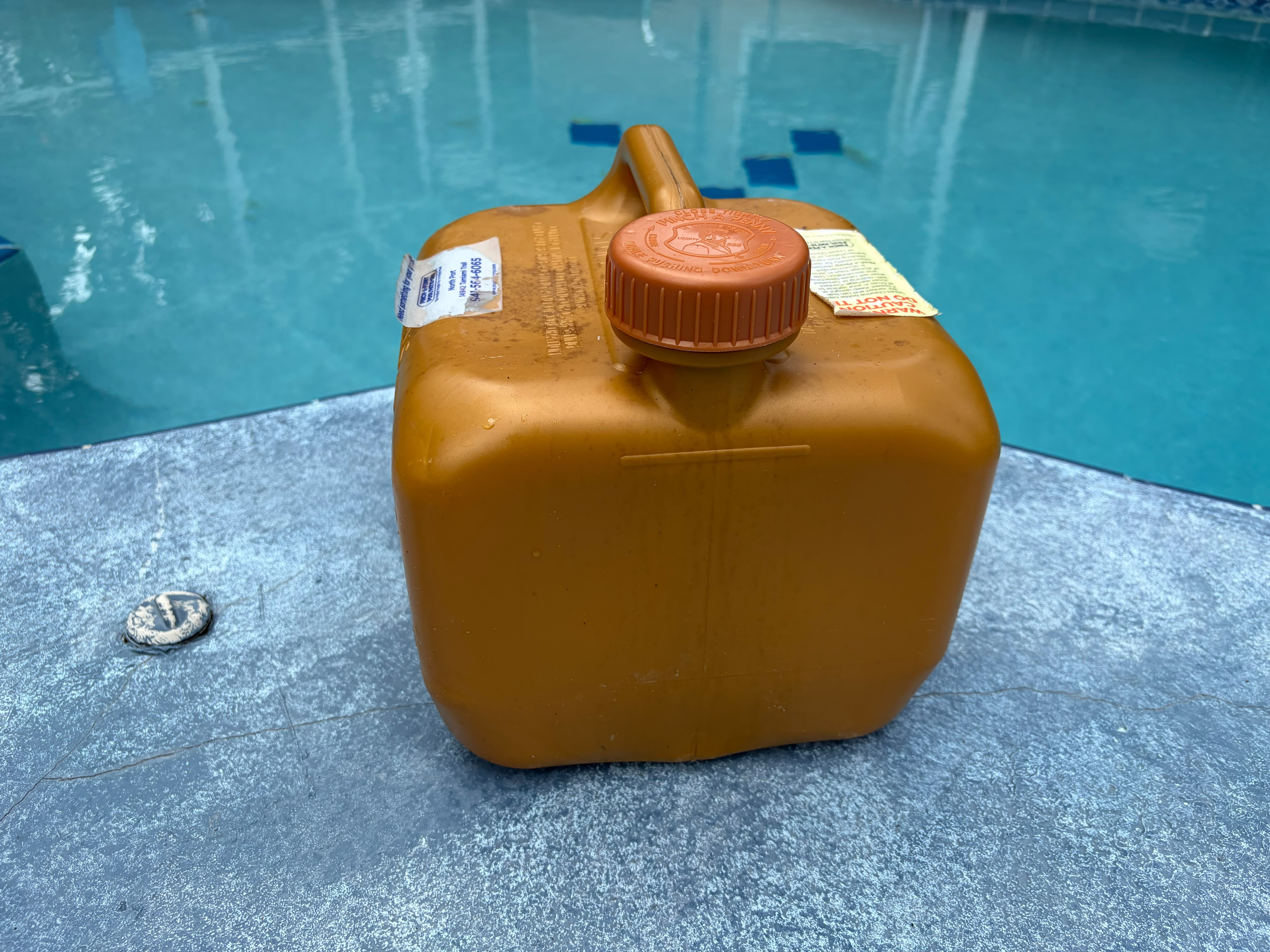
But stabilizer should always be added carefully. It is much easier to add additional CYA later than it is to remove too much.
Can CYA Be Too High?
Absolutely.
This is one of the biggest mistakes we see with stabilized chlorine products.
Cyanuric acid protects chlorine, but that protection comes with a tradeoff. As the concentration of CYA increases, more chlorine exists in forms associated with cyanurate and the disinfecting action of chlorine slows.
The CDC notes that disinfection times become longer when cyanuric acid is present, and its Model Aquatic Health Code discusses how stabilizer affects chlorine's ability to quickly inactivate microorganisms.
This is why excessively high CYA can become problematic and turn a manageable pool into a more difficult water-quality problem.
People sometimes describe this situation as “chlorine lock.” That phrase makes it sound like chlorine suddenly stops working at a specific CYA number.
That isn't really what happens.
There isn't a magical point at which CYA reaches 100 ppm and the chlorine switches off. Instead, as CYA rises, an appropriate free chlorine concentration also becomes increasingly important.
At very high CYA levels, maintaining the necessary chlorine becomes increasingly inconvenient and inefficient.
That can contribute to algae, cloudy water, and persistent sanitation problems even when testing shows chlorine is present in the pool.
How Do CYA Levels Become Too High?
One of the most common causes is the repeated use of trichlor chlorine tablets (tabs).
Trichlor is popular because it is convenient. You put tablets into a chlorinator or floating dispenser and they gradually release chlorine.
But trichlor is a stabilized chlorine product.
Every time trichlor is added, it adds both chlorine and CYA to the pool.
The chlorine gets consumed.
The CYA largely remains until water is removed, replaced, diluted, or lost through normal pool operation.
Over months of tablet use, pools that rely on stabilized tablets for routine chlorination can see CYA gradually climb higher and higher.
This is one reason a pool that looked beautiful earlier in the season can eventually begin having algae problems despite the homeowner continuing to add tablets.
The homeowner may think, “I'm using more chlorine. Why isn't it working?”
The answer may be sitting in the CYA test result.
Does Liquid Chlorine Raise CYA?
No.
Standard liquid chlorine, or sodium hypochlorite, provides chlorine without adding cyanuric acid.
That makes liquid chlorine extremely useful when a pool already has an appropriate CYA concentration.
You can increase the free chlorine level without continuing to raise the stabilizer.
The same general advantage applies to unstabilized chlorine sources such as calcium hypochlorite, commonly called cal hypo, although cal hypo adds calcium and therefore has its own water-balance considerations.
Understanding what each chlorine product adds to the water is an important part of proper pool care.
How Do You Lower High CYA?
Unfortunately, there isn't usually a bottle of chemical you can pour into the pool that reliably makes excessive CYA disappear.
The traditional and most dependable solution is dilution.
That means replacing some of the high-CYA pool water with fresh water.
For example, if a pool has extremely elevated CYA, a calculated partial drain and refill may substantially lower the concentration.
That does not mean homeowners should simply drain their swimming pools without understanding the risks.
Florida has a high groundwater table in many areas, and improperly draining an inground pool can cause serious structural problems. The amount of water removed and the method used should always be appropriate for the pool and local conditions.
Normal splash-out, filter cleaning, water replacement, heavy rain followed by draining, and other dilution can also gradually lower CYA over time.
Cyanuric acid doesn't simply evaporate away with the water like chlorine can disappear under sunlight, so a high CYA problem can persist until enough water has been replaced.
What About CYA in Saltwater Pools?
A saltwater pool still uses chlorine, and the same basic principle applies in a spa with a salt system.
The difference is that instead of the homeowner regularly pouring liquid chlorine into the pool, a saltwater chlorinator converts dissolved salt into chlorine while the system operates.
That chlorine is still exposed to sunlight.
CYA therefore remains important.
Many saltwater chlorine generator systems operate with somewhat higher stabilizer levels than manually chlorinated pools because the generator produces chlorine gradually throughout the pump cycle.
Depending on the system, a CYA concentration around 60 to 80 ppm may be recommended.
Always follow the specifications for the particular salt system installed on the pool rather than assuming every salt pool requires the exact same chemistry.
Should Indoor Pools Use CYA?
Generally, CYA is far less useful in an indoor pool because the pool isn't being exposed to the same direct sunlight.
The CDC's Model Aquatic Health Code does not recommend CYA for indoor aquatic venues because the primary benefit of stabilizer—protecting chlorine from sunlight—is largely absent, while CYA still slows chlorine's disinfecting action.
For backyard outdoor pools in Southwest Florida, however, sunlight protection is obviously a much bigger concern.
How Often Should CYA Be Tested?
CYA should be included in regular pool-water testing so you can monitor it rather than treat it as something that only needs to be checked once.
For a residential pool, checking the pool's CYA levels about once a month is a reasonable routine, and it should also be checked whenever there has been significant dilution, draining and refilling, prolonged tablet use, unexplained chlorine loss, or recurring algae.
Accurate testing becomes especially important when deciding whether to add stabilizer.
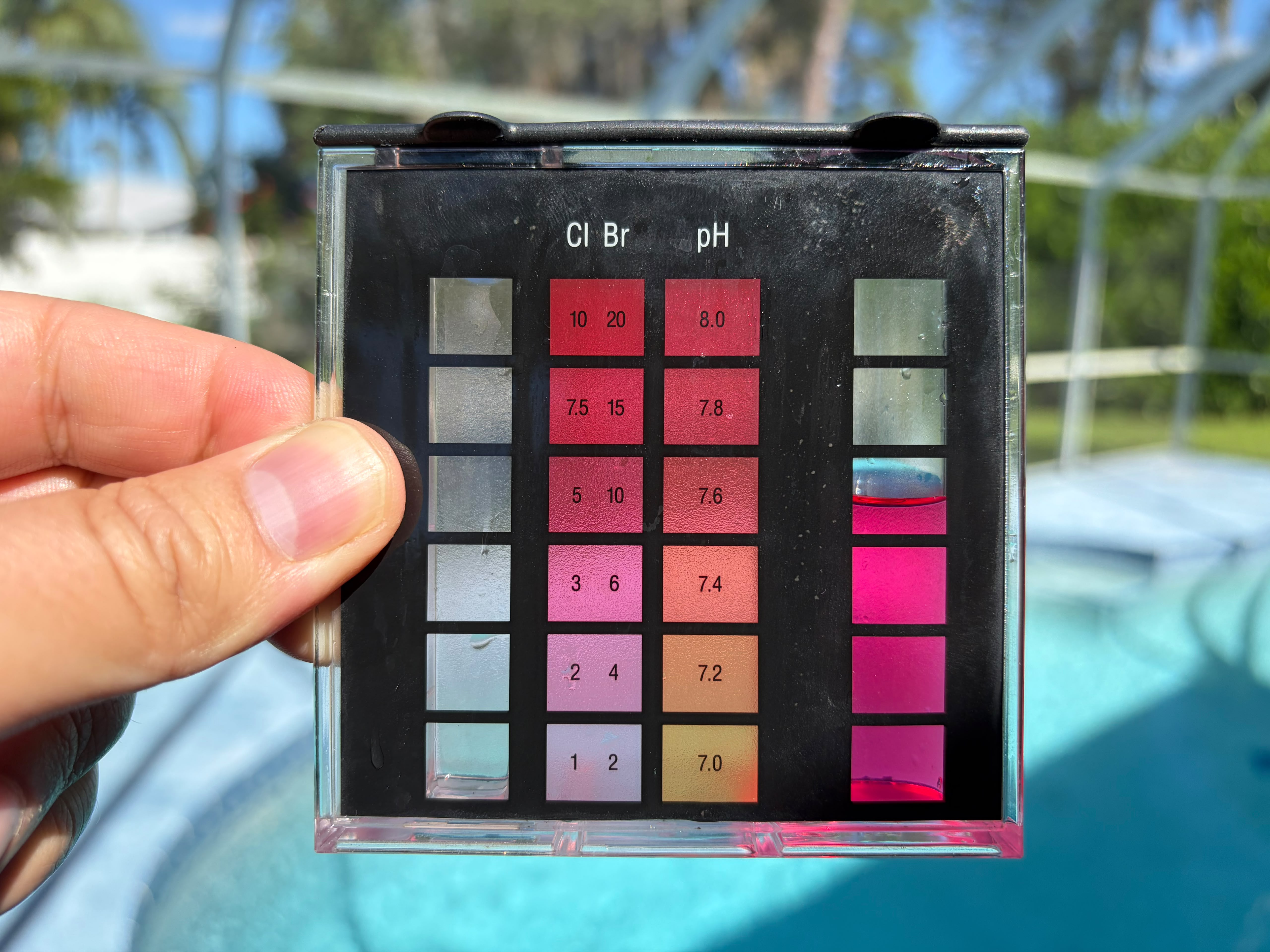
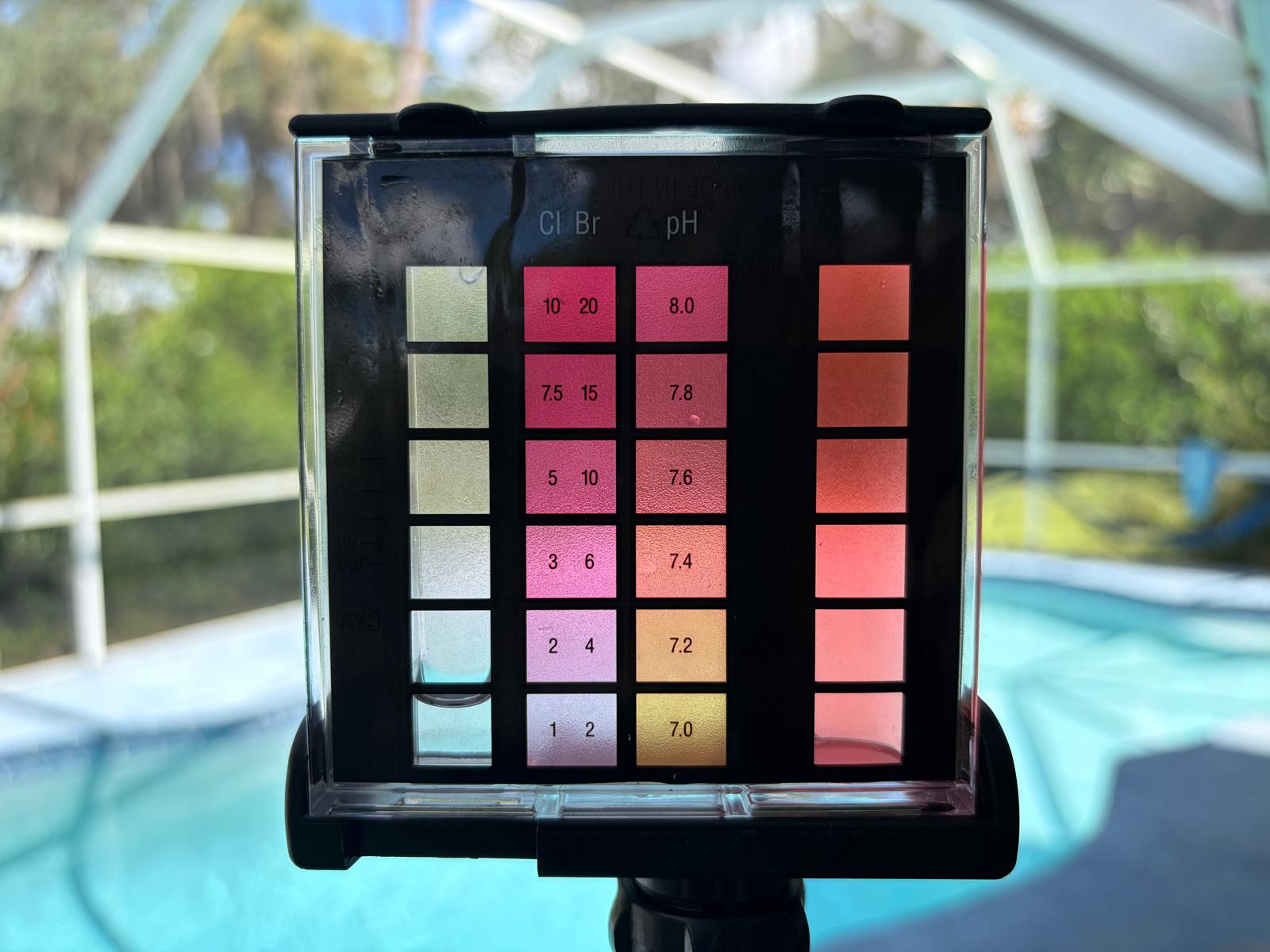
A test strip can provide a quick estimate, but a quality drop-based pool test kit generally gives more useful information for ongoing professional pool maintenance.
At Harbor Line Pool Care, regular water testing is part of our weekly pool cleaning and maintenance, because we look at CYA alongside the rest of the pool chemistry rather than treating one number in isolation.
Free chlorine, pH, total alkalinity, calcium hardness, salt concentration in saltwater pools, and the condition of the filtration and circulation system all play a part.
CYA and Free Chlorine Have to Work Together
This is probably the most important thing to understand about cyanuric acid.
You shouldn't look at a CYA reading by itself.
The pool's free chlorine level and CYA level are related.
As CYA increases, the amount of free chlorine needed for effective pool sanitation also increases, because CYA, also called stabilizer, works by forming an association with chlorine that helps protect it while also slowing how quickly it sanitizes.
You may occasionally see advice stating that free chlorine must always equal exactly 7.5% of the CYA concentration. That percentage comes from one approach to residential pool management, but it shouldn't be treated as a universal rule covering every pool, sanitation system, manufacturer, and regulatory standard.
For example, CDC residential guidance recommends maintaining at least 2 ppm free chlorine when cyanuric acid or stabilized chlorine is being used, while individual equipment manufacturers and pool-care methods may specify different operating targets.
The important principle is simple:
The higher the CYA concentration becomes, the more attention must be paid to maintaining an appropriate free chlorine level.
CYA Is About Balance
Cyanuric acid can look like a minor number on a pool-water test, but it has an enormous impact on how efficiently chlorine performs.
Too little CYA and the Florida sun can destroy chlorine rapidly.
Too much CYA and chlorine becomes increasingly slow and difficult to manage.
The sweet spot is enough stabilizer to protect chlorine from sunlight without allowing CYA to accumulate unnecessarily.
For many traditionally chlorinated residential outdoor pools, that means keeping CYA around 30 to 50 ppm. Saltwater pools may operate higher, commonly around 60 to 80 ppm when recommended by the salt-system manufacturer.
Most importantly, CYA should never be managed independently from free chlorine.
When both are maintained properly, chlorine lasts longer, pool water stays cleaner, algae is easier to prevent, and the entire sanitation system operates more efficiently.
Professional Pool Care in North Port, Florida
Florida's sun, heat, heavy rain, and long swimming season can make maintaining consistent pool chemistry more challenging than it appears.
At Harbor Line Pool Care, our North Port pool service includes professional weekly cleaning, water testing, chemical balancing, equipment checks, and ongoing attention to overall pool condition.
We also provide Port Charlotte pool service for homeowners who want consistent weekly care and professional management of chlorine, CYA, pH, and overall water balance.
Our weekly pool care includes testing and balancing the water, monitoring sanitizer levels, brushing and cleaning the pool, checking equipment operation, and watching important chemistry such as cyanuric acid before small problems become much larger ones.
As we explain in Why Your Pool Water Looks Perfect... Until It Doesn't, a clear pool isn't necessarily a properly balanced pool.
Keeping CYA, chlorine, pH, and the rest of the water chemistry working together is what helps keep your pool clean, comfortable, and ready to swim.